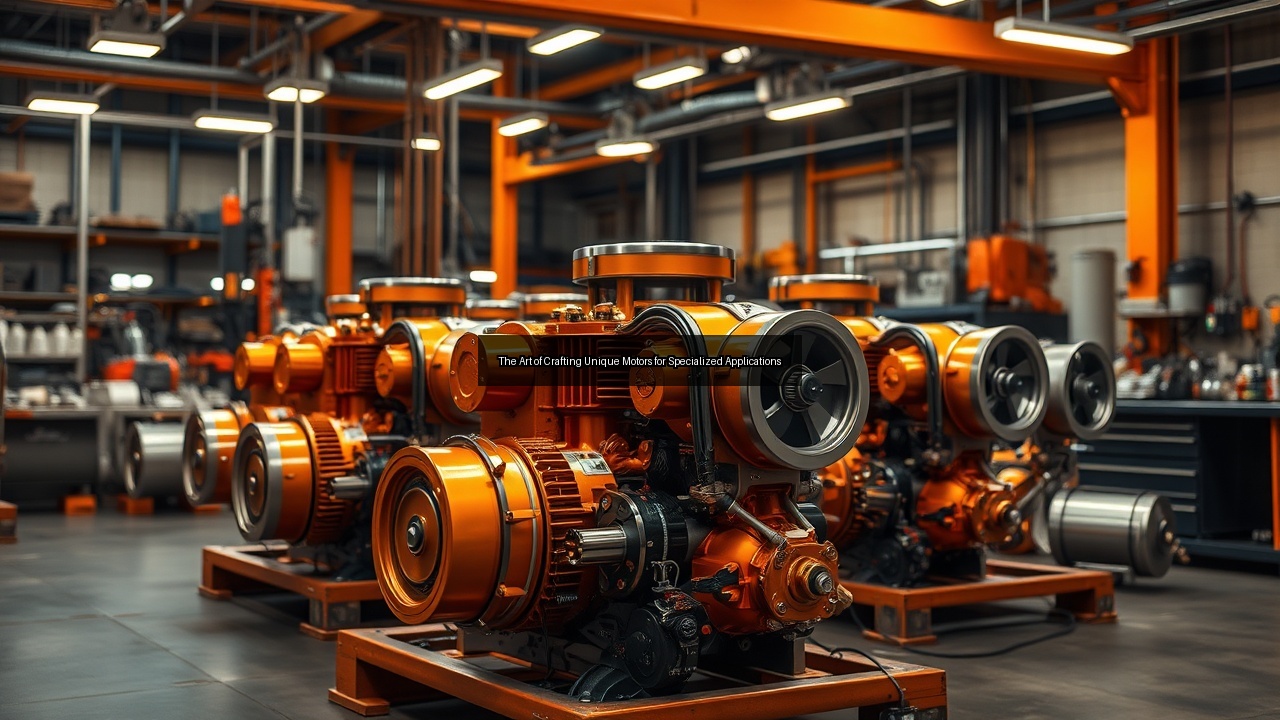
The Art of Crafting Unique Motors for Specialized Applications
Understanding Custom Motors and Their Applications
The Role of Custom Electric Motors in Specialized Industries
Custom motors play a critical role in various specialized industries, providing tailored solutions that standard motors cannot achieve. Industries such as aerospace, automotive, and robotics rely heavily on custom electric motors to meet specific performance requirements. For instance, in the automotive sector, electric motors drive vehicles, including trucks, and hybrid models where efficiency and compact design are paramount. In robotics, precision and control are essential, necessitating the use of customized motors that can provide the exact torque and speed needed for intricate tasks. By integrating unique features tailored to each application, businesses can enhance productivity, reduce energy consumption, and ensure their systems operate at peak performance. Custom motors are not merely alternatives; they are essential components that enable innovation and efficiency in specialized applications.
Key Types of Custom Motors: DC and AC Variations
When considering custom motors, understanding the different types available is crucial. Direct current (DC) motors and alternating current (AC) motors each offer unique benefits and functionalities. DC motors are favored for their simplicity and ease of control, making them ideal for applications requiring variable speed and torque. Conversely, AC motors, including synchronous and induction motors, are often used for applications demanding high efficiency and durability. Customization can involve enhancing either type with specific features such as gear systems or integrating sensors to monitor performance. Each motor type's adaptability allows manufacturers to create solutions that meet the precise needs of their clients, whether in electric vehicle design or industrial automation.
Benefits of Tailoring Motors for Specific Needs
Tailoring motors for specific needs brings numerous advantages that can significantly impact operational efficiency and performance. Customized motors can enhance reliability and efficiency by aligning closely with application requirements, such as speed, torque, and energy consumption. This alignment often results in reduced energy costs, as motors can operate more efficiently under the conditions for which they were designed. Additionally, tailored motors can lead to improved longevity, reducing maintenance costs and downtime. Businesses that invest in custom electric motors often find their systems more responsive and capable of handling complex tasks that standard motors may struggle with. The ability to adapt designs to meet specialized needs ultimately drives innovation and competitiveness in the market.
Designing Unique Motors for Specialized Applications
Precision Engineering: The Backbone of Custom Motor Design
Precision engineering stands as the cornerstone of custom motor design. This meticulous approach ensures that every component of the motor functions optimally within its intended application. Engineers employ advanced computer-aided design (CAD) tools and simulation techniques to create detailed models, allowing for thorough testing and refinement before production. Factors such as material selection, dimensional accuracy, and thermal management are carefully considered to enhance performance and reliability. This level of precision is particularly vital in applications like aerospace, where safety and performance are non-negotiable. Custom electric motors designed with precision engineering can achieve higher efficiency, lower noise levels, and extended service life, making them indispensable in specialized fields.
Synchronous Motors vs. Induction Motors: Choosing the Right Type
Choosing between synchronous motors and induction motors is vital in the design process of custom motors. Synchronous motors operate at a constant speed and are ideal for applications requiring precise timing and control. They are commonly used in industrial settings where synchronization with other machinery is crucial. Conversely, induction motors are simpler, robust, and more cost-effective, making them suitable for many general applications. By understanding the strengths and limitations of each type, engineers can craft motors that meet specific operational demands. For instance, a custom servo motor designed for automation tasks may benefit from the precision of synchronous technology, while an induction motor could be more appropriate for heavy-duty applications involving gear systems.
Brushless DC Motors: Advantages for Modern Applications
Brushless DC motors (BLDC) have gained popularity due to their numerous advantages in various applications. Unlike traditional DC motors, brushless models eliminate the need for brushes, resulting in reduced maintenance and increased reliability. This design allows for higher efficiency and quieter operation, making BLDC motors ideal for sensitive applications like medical devices and consumer electronics. Additionally, their compact size and lightweight design enable integration into spaces where traditional motors would be impractical. Customizing brushless DC motors for specific tasks can further enhance their performance, integrating features such as speed sensors or advanced control algorithms to optimize operation. As technology evolves, the application of brushless motors continues to expand, influencing the development of innovative solutions across multiple industries.
Manufacturing and Inventory Considerations for Custom Motors
Streamlining the Manufacturing Process for Efficiency
Efficient manufacturing processes play a crucial role in the successful production of custom motors. Streamlining operations reduces lead times and costs, enhancing overall productivity. Implementing lean manufacturing principles, such as minimizing waste and optimizing workflow, can significantly improve efficiency. Automation and advanced machining techniques, including CNC machining and 3D printing, can also contribute to faster production times and increased precision. Additionally, adopting a just-in-time (JIT) inventory strategy ensures that materials are available as needed, reducing excess inventory and associated costs. By focusing on efficiency in manufacturing, companies can meet the rising demand for customized motors while maintaining high-quality standards and responsiveness to market changes.
Managing Inventory for Customized Motors: Best Practices
Effective inventory management for customized motors is essential to meet the varying demands of specialized applications. Implementing best practices such as demand forecasting, inventory turnover analysis, and supplier relationship management can help optimize stock levels. Accurate forecasting allows manufacturers to anticipate customer needs and adjust production schedules accordingly. Additionally, utilizing inventory management software can streamline tracking and reporting, providing real-time insights into stock levels and order statuses. Maintaining a balance between having enough inventory to meet demand and minimizing excess stock is crucial for cost control. By adopting these practices, companies can ensure they have the right components available for custom motor production, enhancing responsiveness and customer satisfaction.
The Importance of Quality Control in Custom Motor Production
Quality control is paramount in the production of custom motors, ensuring that each unit meets the rigorous standards required for specialized applications. Implementing a robust quality management system involves thorough testing and inspection at every production stage, from raw materials to final assembly. Techniques such as statistical process control (SPC) and failure mode and effects analysis (FMEA) help identify potential issues before they escalate. Consistent quality checks not only enhance product reliability but also build customer trust. For industries where performance and safety are critical, maintaining high-quality standards in custom motor production is non-negotiable. This commitment to quality directly impacts a company's reputation and competitiveness in the market.
Future Trends in Custom Motor Development
Emerging Technologies in Electric Motors
The field of custom motors is evolving rapidly, driven by emerging technologies that promise to enhance performance and efficiency. Innovations such as advanced materials, including composites and nanomaterials, enable the design of lighter and more energy-efficient motors. Additionally, the integration of smart technologies, like IoT connectivity, allows for real-time monitoring and control, further optimizing motor performance. These advancements not only improve the functionality of custom electric motors but also pave the way for new applications in sectors like renewable energy and electric vehicles. Staying ahead of these trends is essential for manufacturers looking to maintain competitiveness in an increasingly technology-driven market.
The Rise of Servo Motors in Automation
Servo motors have become increasingly vital in modern automation applications, offering precise control and efficiency. Their ability to deliver accurate positioning and speed control makes them indispensable in robotics, CNC machinery, and conveyor systems. Custom servo motors can be designed to meet the specific needs of various industries, ensuring optimal performance in complex tasks. The growing demand for automation solutions drives the need for tailored servo motors that can seamlessly integrate into existing systems. As manufacturers explore new ways to enhance automation, the customization of servo motors will play a pivotal role in driving innovation and efficiency.
Sustainability and Innovation in Custom Motor Design
The push for sustainability in manufacturing has prompted a significant shift in custom motor design. Companies are increasingly focusing on creating energy-efficient motors that minimize environmental impact. This trend includes the development of motors that utilize renewable energy sources, reducing reliance on fossil fuels. Innovations in design and materials also contribute to sustainability, as manufacturers seek to create longer-lasting products that require fewer resources over their lifecycle. Emphasizing sustainable practices not only meets regulatory requirements but also aligns with consumer expectations for environmentally responsible products. The future of custom motors will undoubtedly be shaped by this commitment to sustainability, driving both innovation and market growth.